

The History of Glen Moray Distillery:
Located in the heart of Elgin, Glen Moray Distillery has played a significant role in the whisky-making heritage of Speyside for well over a century. The site originally operated as the West Brewery before being converted into a whisky distillery in 1897 during a period of rapid growth in Scotland’s whisky industry. The fertile lands of Moray and the pure waters of the River Lossie provided ideal conditions for producing high-quality single malt Scotch whisky.
Like many Scottish distilleries, Glen Moray faced challenges throughout its history. Economic difficulties in the early twentieth century led to periods of closure, but the distillery survived and gradually re-established itself as a respected producer of Speyside whisky. During the mid-twentieth century, substantial investment helped modernise production while preserving traditional whisky-making methods.
Glen Moray became particularly well known for its willingness to experiment with different oak casks. While many distilleries relied primarily on traditional bourbon barrels, Glen Moray explored alternative wood finishes, including sherry, port, and wine casks. These innovations contributed to the development of distinctive flavour profiles while helping the distillery build an international reputation.
Today, Glen Moray remains one of Elgin’s most significant industrial landmarks. Visitors from around the world travel to the distillery to learn about the centuries-old craft of whisky production and the important role the industry has played in shaping the economy and culture of Moray. Its continued success reflects both the rich traditions of Speyside whisky making and a commitment to innovation that has defined the distillery throughout its history.
Conclusion:
From its origins as a Victorian brewery to its position as an internationally recognised Speyside distillery, Glen Moray’s story is one of resilience, craftsmanship, and innovation. More than 125 years after its founding, the distillery continues to embody the spirit of Moray, producing whiskies that celebrate the region’s proud heritage while looking towards the future.
Malting and Milling: Raw Materials and Traditional Practice:
The foundation of every Glen Moray whisky lies in the careful preparation of malted barley. While modern distilleries use advanced equipment and quality control systems, the principles behind malting and milling have remained largely unchanged for centuries. This stage is where the grain is transformed into a form that can release the sugars required for fermentation and, ultimately, whisky production.
Historically, barley harvested from Scotland’s fertile farming regions would be steeped in water and spread across malting floors. As the grain began to germinate, natural enzymes were activated within each kernel. These enzymes are essential because they break down complex starches into simpler sugars that can later be converted into alcohol by yeast. Distillery workers regularly turned the barley by hand to ensure even germination and to prevent excessive heat from building up.
Once the desired level of germination had been reached, the barley was dried in a kiln. This stopped the growth process while preserving the valuable enzymes. The kilning stage also influenced flavour. Distilleries that used peat-fired kilns produced smoky characteristics, whereas Glen Moray’s Speyside style traditionally favoured a lighter, cleaner malt profile with little or no peat influence.
After malting, the barley is transported to the mill house, where it is crushed into grist. This is a crucial step that requires precision. The grain must be broken open sufficiently to expose the starch-rich interior while retaining the husk. Too much flour can cause problems during mashing, while overly coarse grist can reduce sugar extraction and lower efficiency.
The resulting grist consists of three main components: husks, grits, and flour. The husks form a natural filter bed during mashing, allowing the sweet liquid, known as wort, to be separated from the solid material. Achieving the correct balance is a key responsibility of the distillery team, as it directly affects both production efficiency and the quality of the spirit.
Although visitors often focus on the copper stills and maturation warehouses, whisky production truly begins with the grain. The attention given to malting and milling at Glen Moray reflects a wider Speyside tradition in which consistency, craftsmanship, and quality control are essential at every stage of the whisky-making process. The care taken during these early steps helps create the smooth, fruity and approachable character for which Glen Moray is known around the world.


Mashing at Glen Moray Distillery:
Mashing is one of the most important stages in whisky production at Glen Moray Distillery. Following milling, the grist is transferred to a large stainless-steel mash tun, where it is mixed with carefully controlled quantities of hot water. The purpose of mashing is to extract as much fermentable sugar as possible from the malted barley.
The process begins with the first addition of hot water at a temperature designed to activate the enzymes developed during malting. These enzymes break down the starches within the barley into soluble sugars, producing a sweet liquid known as wort. The wort forms the foundation for the alcohol that will later be created during fermentation.
Several water additions are typically made during the mashing process. The first water produces the richest and sweetest wort, while subsequent waters extract any remaining sugars from the grain. Each stage is carefully monitored to ensure maximum efficiency and consistency. The final water may be reused in the next mash, helping the distillery maintain both quality and sustainability.
Once the sugars have been extracted, the clear wort is separated from the spent grains. The grain residue, known as draff, is not wasted and is often supplied to local farmers as nutritious animal feed. The wort itself is then cooled before being transferred to the washbacks for fermentation.
At Glen Moray, the quality of the mashing process plays a significant role in defining the character of the spirit. Efficient sugar extraction helps create a clean and balanced wort, which contributes to the light, smooth, and fruity profile that is characteristic of Glen Moray’s Speyside single malt whiskies. Careful control of temperature, water quality, and timing ensures that each mash provides the ideal starting point for the next stage of production.
Key Facts
- Grist is mixed with hot water in the mash tun.
- Enzymes convert barley starches into fermentable sugars.
- The sweet liquid produced is called wort.
- Multiple water additions maximise sugar extraction.
- Spent grain (draff) is often used as animal feed.
- The wort is cooled before moving to fermentation.
This stage bridges the gap between raw ingredients and alcohol production, making it one of the most crucial steps in creating Glen Moray’s distinctive Speyside whisky.
Fermentation at Glen Moray Distillery:
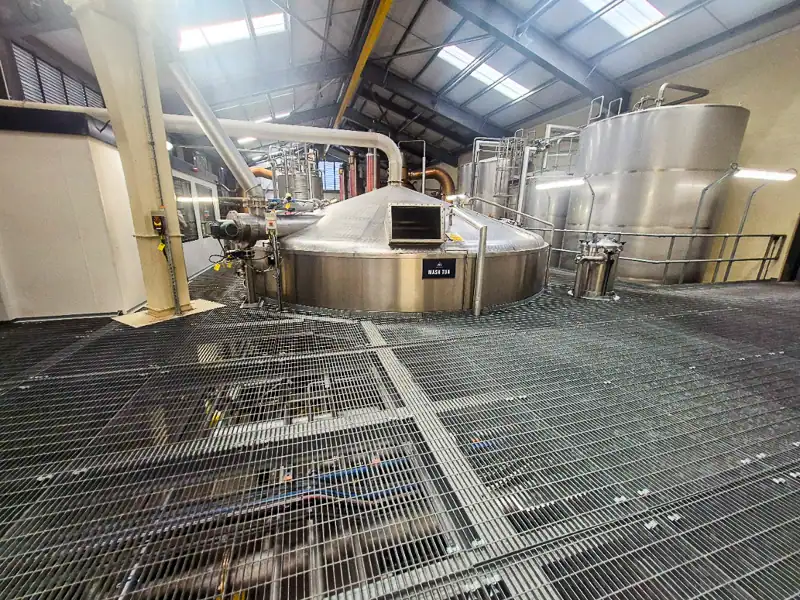
Following mashing, the sweet wort is cooled and transferred into large vessels known as washbacks. At this stage, yeast is added to begin the fermentation process, one of the most important stages in whisky production.
During fermentation, the yeast feeds on the natural sugars extracted from the malted barley. As the sugars are consumed, the yeast produces alcohol, carbon dioxide, and a wide range of flavour compounds. This process typically lasts between 50 and 70 hours, although longer fermentation times can encourage the development of additional fruity characteristics.
As fermentation progresses, the liquid becomes increasingly active, generating heat and creating a frothy surface. The interaction between the yeast and sugars produces esters and other compounds that contribute to the rich fruit notes often associated with Speyside whiskies. These flavours will carry through distillation and help define the final spirit.
By the end of fermentation, the liquid, known as wash, has an alcohol content of around 8% ABV and resembles a strong, un-hopped beer. Although it is not yet whisky, the quality and character of the wash play a crucial role in determining the flavour of the final product.
At Glen Moray, careful control of fermentation time, temperature, and yeast activity helps promote the light, smooth, and fruity house style for which the distillery is known. The wash is then ready to move to the next stage: distillation in the copper pot stills.
Key Facts
- Wort is transferred from the mash tun to the washbacks.
- Yeast converts sugars into alcohol and carbon dioxide.
- Fermentation typically lasts 50-70 hours.
- The resulting wash reaches about 8% alcohol.
- Fruity flavour compounds develop during this stage.
- The wash is then sent for distillation.
This stage is where the sugars extracted from the barley are transformed into alcohol, laying the foundation for Glen Moray’s distinctive Speyside single malt whisky.
Distillation at Glen Moray Distillery:
Distillation is the stage where the alcoholic wash is transformed into a clear spirit that will eventually mature into whisky. At Glen Moray Distillery, this process takes place in traditional copper pot stills, a method that has been used throughout Scotland for generations.
The wash, which contains approximately 8% alcohol, is first heated in the wash still. As the temperature rises, alcohol evaporates before water, creating vapours that travel up through the neck of the still. These vapours pass into condensers, where they are cooled and returned to liquid form. The resulting liquid, known as low wines, contains a higher concentration of alcohol but is not yet ready for maturation.
The low wines are then transferred to the spirit still for a second distillation. This crucial stage further refines the spirit and allows the distillery team to separate it into three parts: the foreshots, the heart of the run, and the feints. The foreshots contain undesirable compounds and are discarded, while the feints are collected for redistillation. Only the heart, the purest and most balanced portion of the spirit, is selected to become Glen Moray whisky.
The design of Glen Moray’s copper stills plays an important role in shaping the character of the spirit. Their shape encourages reflux, whereby heavier vapours condense and fall back into the still while lighter vapours continue their journey. This process contributes to the light, elegant, and fruity style that is characteristic of Glen Moray’s Speyside single malts.
The newly distilled spirit, often referred to as new make spirit, emerges clear and colourless with fresh notes of fruit, malt, and sweetness. Although it already possesses many of the flavour characteristics associated with Glen Moray, it must now undergo years of maturation in oak casks before it can be called Scotch whisky.
Key Facts
- Distillation takes place in traditional copper pot stills.
- The first distillation produces low wines.
- The second distillation refines the spirit further.
- Only the heart of the run is selected for maturation.
- Copper helps remove unwanted sulphur compounds.
- The spirit leaves the still clear and colourless before cask ageing.
This stage is the heart of whisky production, where skill, experience, and careful control combine to create the signature spirit that forms the foundation of every Glen Moray single malt.

Maturation at Glen Moray Distillery:
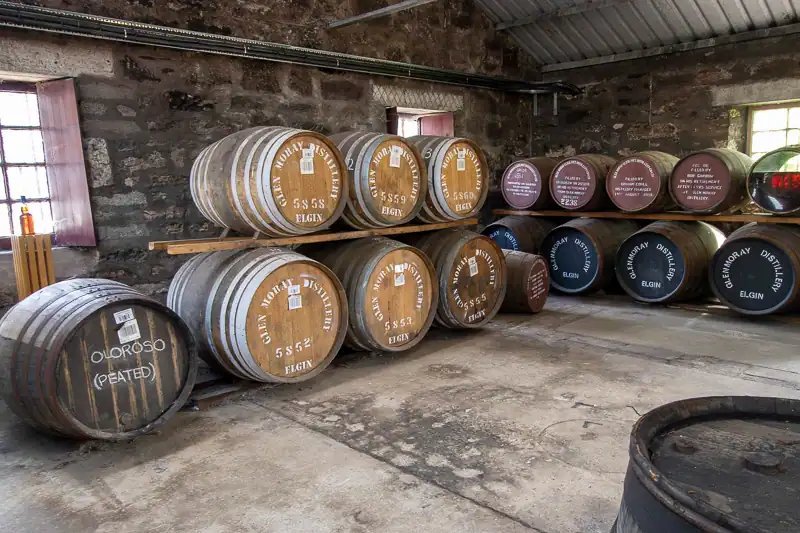
Once distillation is complete, the clear new make spirit begins the longest and most important stage of whisky production: maturation. The spirit is filled into oak casks, where it will spend years developing the colour, aroma, and flavour characteristics that define Glen Moray single malt whisky.
The choice of cask plays a crucial role in the maturation process. Glen Moray traditionally matures much of its spirit in American oak ex-bourbon barrels, which contribute notes of vanilla, honey, caramel, and gentle spice. The distillery is also well known for using a variety of finishing casks, including sherry, port, and wine casks, to create additional layers of complexity and character.
As the whisky rests in the warehouse, it slowly interacts with the oak. The wood allows small amounts of air to enter the cask, encouraging gradual oxidation and helping the spirit mature. At the same time, natural compounds within the oak are absorbed into the whisky, adding flavour, colour, and texture. Over time, the new make spirit becomes smoother, richer, and more balanced.
A small percentage of the whisky evaporates through the cask each year, a phenomenon traditionally known as the “angel’s share.” While this reduces the volume of whisky available for bottling, it is an essential part of the maturation process and contributes to the concentration of flavours.
Distillery staff regularly sample casks to monitor their progress and determine when the whisky has reached its optimum character. Some expressions are bottled after relatively short maturation periods, while others remain in the warehouse for many years to develop greater depth and complexity.
Key Facts
- New make spirit is filled into oak casks.
- American oak ex-bourbon barrels are widely used.
- Sherry, port, and wine casks may be used for finishing.
- Oak contributes colour, flavour, and aroma.
- Maturation softens and develops the spirit over time.
- The “angel’s share” refers to natural evaporation during ageing.
- Casks are monitored regularly to ensure quality.
Maturation transforms Glen Moray’s clear spirit into a distinctive Speyside single malt, allowing time, oak, and craftsmanship to shape the whisky’s final character
Bottling at Glen Moray Distillery:
Bottling is the final stage of the whisky-making process, where years of craftsmanship and maturation are brought together before the whisky reaches consumers around the world. Once the whisky has achieved the desired character and maturity, selected casks are carefully assessed and prepared for bottling.
Before bottling, Glen Moray’s whisky may be married, a process in which whiskies from different casks are combined to create a consistent flavour profile. This ensures that each bottle reflects the distillery’s signature Speyside style. The whisky is then reduced to the required bottling strength using pure water, while preserving its balance of flavours and aromas.
Depending on the expression, the whisky may undergo filtration to remove any natural particles that could appear when chilled. This step helps maintain clarity while ensuring the whisky remains visually appealing to consumers.
Following quality checks, the whisky is bottled, labelled, and packaged. Every bottle undergoes strict quality control procedures to ensure that it meets Glen Moray’s standards before being distributed to retailers and markets across the globe.
Although bottling is the final stage of production, it represents the culmination of a process that began years earlier with barley, water, and yeast. The result is a finished single malt whisky that reflects both the traditions of Speyside and Glen Moray’s commitment to quality and craftsmanship.
Key Facts
- Matured whisky is selected from carefully monitored casks.
- Different casks may be married together for consistency.
- Whisky is reduced to bottling strength using water.
- Some expressions undergo filtration before bottling.
- Bottles are labelled, packaged, and quality checked.
- The finished whisky is distributed worldwide.
For Glen Moray, bottling marks the completion of a journey that can take many years, transforming a clear new make spirit into a refined Speyside single malt ready to be enjoyed by whisky enthusiasts around the world.